
Flagr use cases
Feature flags, A/B tests, and dynamic config often ship as three products. In Flagr they are one flag and one evaluation call (POST /api/v1/evaluation by default).
Start with a kill switch. Add segments for rollouts. Split variants for experiments. Hang JSON on variants when you need config. Same client call the whole way.
A rollout cares who is on. An experiment cares what they saw and whether they converted. Flagr assigns; your app renders; exposure logging and your warehouse do the rest.
| If you are building… | Start here |
|---|---|
| On/off or gradual rollout | Feature flagging |
| UI or server A/B | Experimenting |
| Tunables without redeploys | Dynamic configuration |
| Browser or cache-friendly eval | GET evaluation |
Note: Examples use API field names
variantID,variantKey, andvariantAttachment(camelCase), as returned byPOSTorGET /evaluation.
Feature flagging
The smallest useful question is whether a code path runs. A kill switch flips that from the UI without a redeploy. The same flag scales to targeted rollouts: staff first, one region, then everyone. Deploy and release stop being the same event.
Boolean on/off template
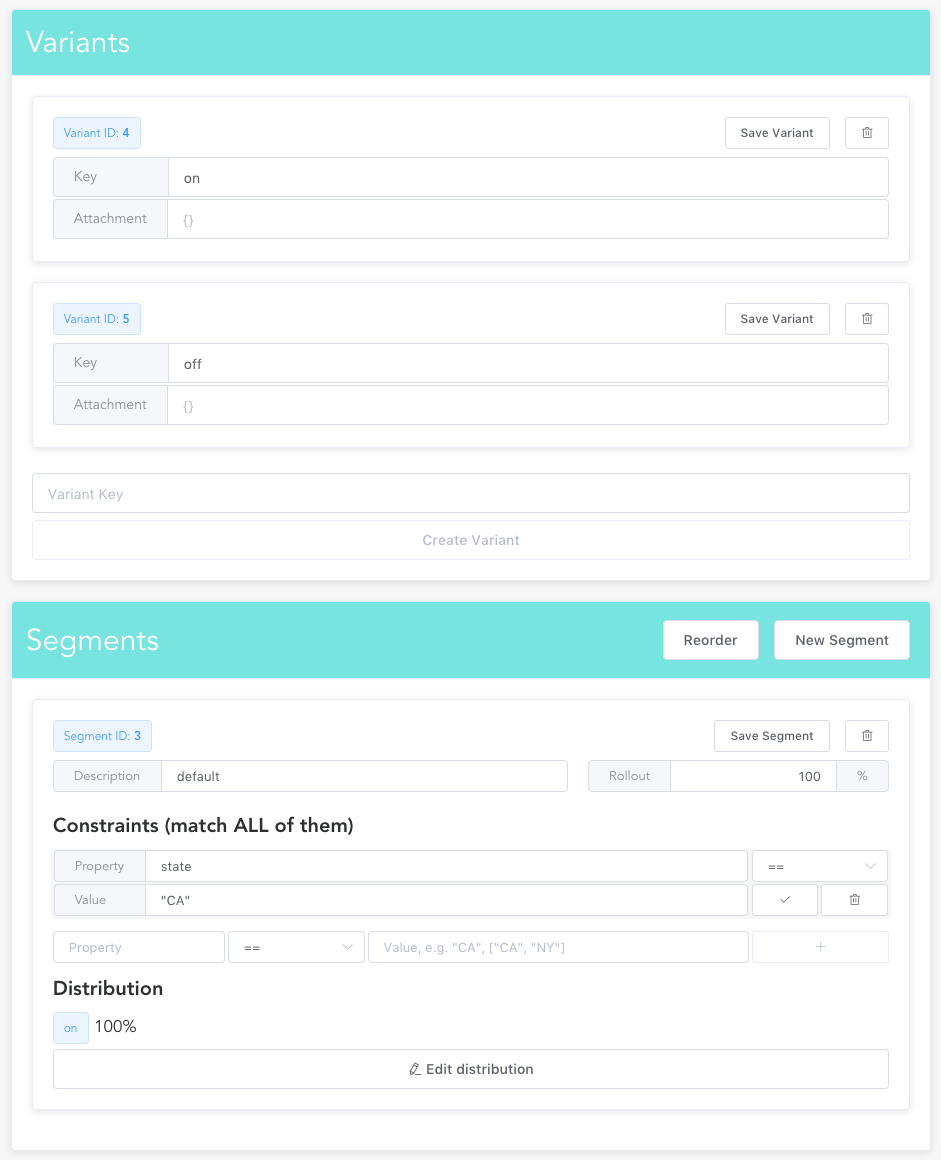
Two variants (on / off), one segment at 100% on:
Variants
  - on
  - off

Segment
  - Constraints: none (everyone)
  - Rollout Percent: 100%
  - Distribution
    - on: 100%
    - off: 0%
Evaluate once per entity and branch on variantKey:
const result = await flagr.postEvaluation(entity);

if (result.variantKey === "on") {
  // enabled for this entity
} else {
  // off, or no assignment (empty variantKey)
}
That shape is convention, not a special flag type. Grow the same flag without changing the call site:
- Audience - constraints on
entityContext(state == "CA",tier == "beta"). - Gradual rollout - lower segment rollout percent (10% → 50% → 100%).
- Experiment - more variants and a split distribution.
- Config - JSON on each variant via Attachment.
The flag-level enabled switch is separate. When enabled is false, evaluation returns blank before segments run (PUT /api/v1/flags/{id}/enabled or the UI toggle).
To fork segments, variants, and tags: POST /api/v1/flags/{flagID}/duplicate or Duplicate Flag in the UI. The clone gets a new key and (cloned) in the description unless you override key / description in the body.
Experimenting - A/B testing
Add another "on-like" variant and the question becomes which experience wins? Same flag, same POST /evaluation, finer distribution. Flagr gives sticky assignment (entityID + unchanged flag → same variantKey). Significance math stays in your stack; Flagr can emit events if you wire recorders.
Control and treatment (naming)
control and treatment are your labels. The evaluator treats every variant the same. Name a baseline control so warehouse queries stay obvious.
Note: Flagr does not require a
controlvariant. It only records thevariantKeyyou configured.
const result = await flagr.postEvaluation(entity);

if (result.variantKey === "control") {
  // baseline checkout
} else if (result.variantKey === "treatment1") {
  // single-page checkout
} else if (result.variantKey === "treatment2") {
  // accordion checkout
}
Warning: Segments run in order. The first segment whose constraints all match wins, then evaluation stops - even if rollout leaves
variantKeyempty. Put narrow rules above catch-alls. Full rule: behavioral contracts: segment evaluation.
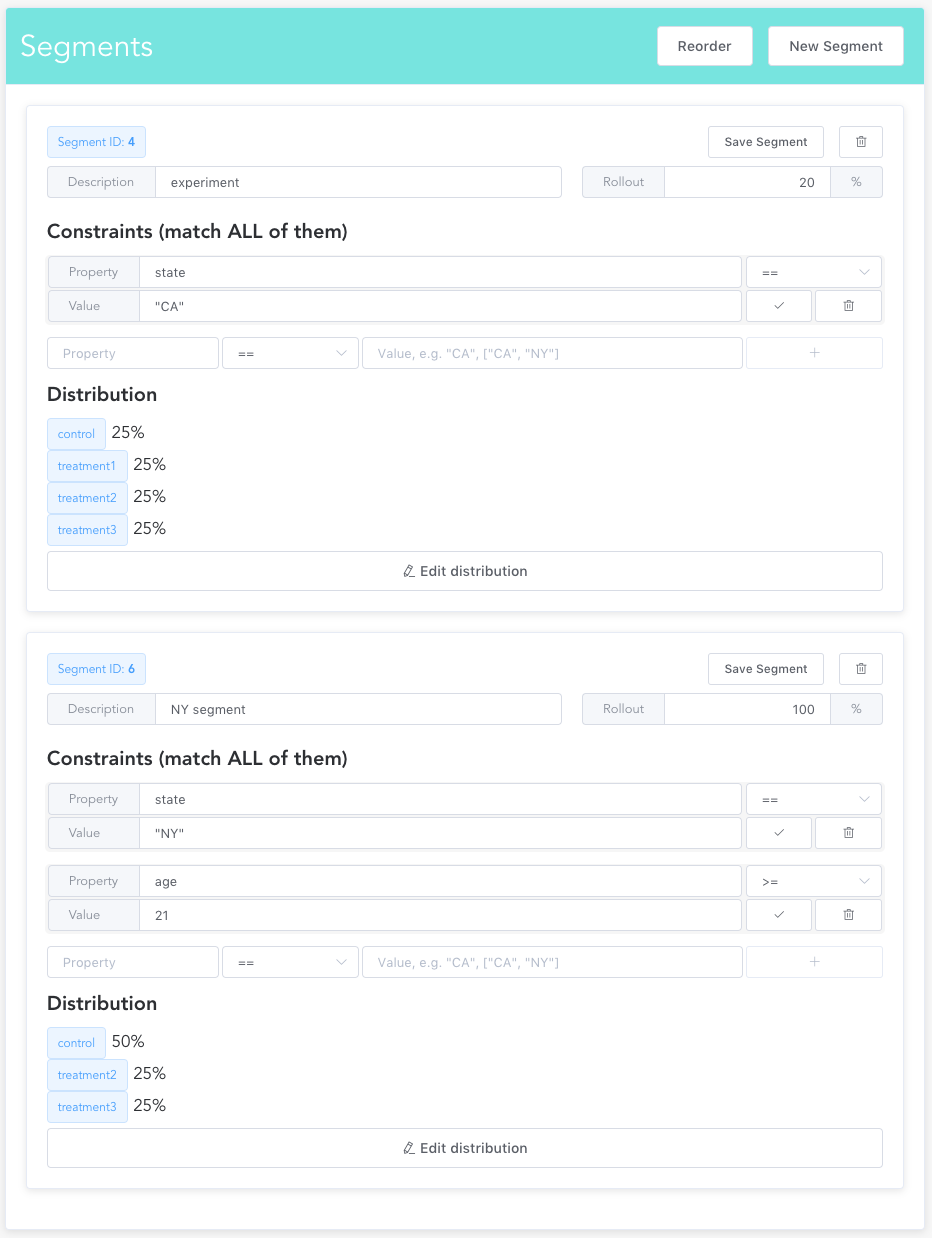
Example layout:
Variants
  - control
  - treatment1
  - treatment2
  - treatment3

Segment                         // state == "CA"
  - Constraints (state == "CA")
  - Rollout Percent: 20%
  - Distribution
    - control:    25%
    - treatment1: 25%
    - treatment2: 25%
    - treatment3: 25%

Segment                         // state == "NY" AND age >= 21
  - Constraints (state == "NY" AND age >= 21)
  - Rollout Percent: 100%
  - Distribution
    - control:    50%
    - treatment1:  0%
    - treatment2: 25%
    - treatment3: 25%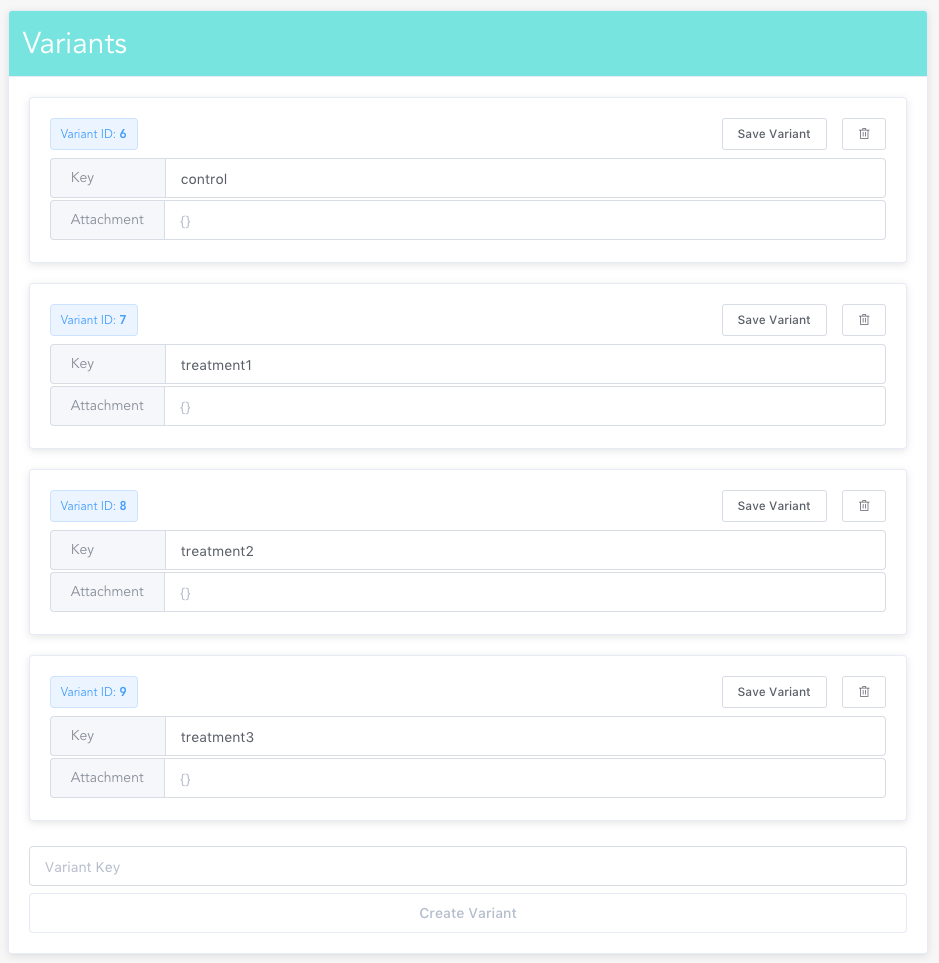
Measuring outcomes
POST /evaluation alone is enough for many assignment metrics. For a rigid A/B denominator (who actually saw the treatment), log exposure after render (Exposure logging), then pipe rows through Data recorders & A/B analysis or your own consumer. Eval volume only: Datar.
Dynamic configuration
Sometimes the flag carries a value, not a branch: cache TTL, button copy, retry timeout. Each variant's Attachment is arbitrary JSON next to variantKey. One evaluation call; no second config service.
const result = await flagr.postEvaluation(entity);
const colorHex = result.variantAttachment["color_hex"];
Example flag:
Variants
  - green
    - attachment: {"color_hex": "#42b983"}
  - red
    - attachment: {"color_hex": "#ff0000"}

Segment
  - Constraints: null
  - Rollout Percent: 100%
  - Distribution
    - green: 100%
    - red: 0%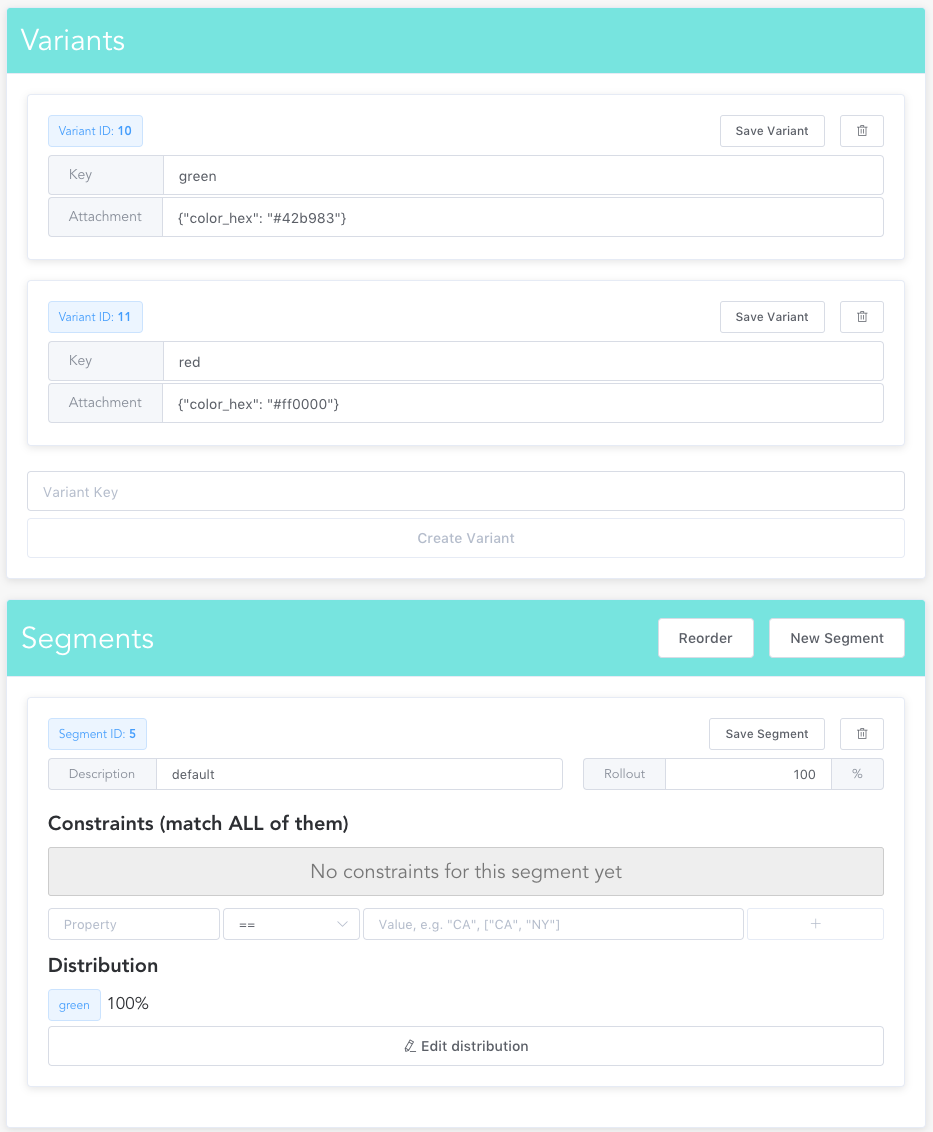
Note: Before v1.1.3, attachments were
string:stringmaps. Current Flagr usesmap[string]anyfor arbitrary JSON.
GET evaluation (browser-friendly)
POST is the default for servers, SDKs, and large entityContext. GET carries the same evalContext or batch body, URL-encoded in a single json= query param, when you need a CORS-simple request or HTTP caching in the browser.
Motivation: issue #613. Shape: PR #631. The Debug Console still uses POST only.
| POST (primary) | GET (secondary) | |
|---|---|---|
| Best for | Backends, SDKs, rich context, batch | Browser fetch without preflight, preload, shared links |
| Payload | JSON body | ?json= (length capped; see below) |
| Privacy | Body rarely lands in URL logs | Full request often in access logs, Referer, history |
| Caching | Not by default | By full URL when safe |
Use GET only with small, non-sensitive context and stable JSON serialization. When unsure, POST.
Wire format
| Method | Path | json decodes to |
|---|---|---|
GET | /api/v1/evaluation | evalContext (same as POST body) |
GET | /api/v1/evaluation/batch | evaluationBatchRequest |
const ctx = {
  entityID: 'user-1',
  entityType: 'user',
  entityContext: { tier: 'premium' },
  flagID: 42,
};

await fetch('/api/v1/evaluation', {
  method: 'POST',
  headers: { 'Content-Type': 'application/json' },
  body: JSON.stringify(ctx),
});

const url = `/api/v1/evaluation?json=${encodeURIComponent(JSON.stringify(ctx))}`;
await fetch(url);
Batch: GET /api/v1/evaluation/batch?json=${encodeURIComponent(JSON.stringify(batchRequest))}.
Security and validation
Everything lives in json=, so treat the URL like a sensitive query string. Avoid secrets and PII you would not put in a GET. Personalized GET URLs can return the wrong assignment if a CDN or browser caches them. Skip enableDebug: true on URLs you might cache or forward.
After decode, GET runs the same Validate / ContextValidate as POST on evalContext and batch bodies. GET also enforces raw query length ≤ FLAGR_EVAL_GET_MAX_URL_BYTES (default 8192; 0 disables the check). Invalid JSON → 400. Unknown flags and non-matching segments still → 200 with empty or partial results. POST may surface 422 from go-swagger on bind; GET uses 400 with a json is not valid … message.
Auth whitelists often leave evaluation open by default. Review Environment variables.
URL length (FLAGR_EVAL_GET_MAX_URL_BYTES)
Flagr counts the raw query string only (json=… after encoding), not the full URL. Over the cap → 400 with a message to use POST.
Source of truth: FLAGR_EVAL_GET_MAX_URL_BYTES in pkg/config/env.go (default 8192). Handler: pkg/handler/eval.go. Size fixtures: go test ./pkg/handler -run TestGetEvalQuerySizesDocumentsTypicalPayloads -v.
Typical fixtures in this repo land around ~100-250 bytes for a single eval and ~200-500 for a modest batch (a few percent of the 8192 default). The default lines up with common ~8 KB request-line limits (e.g. Apache LimitRequestLine 8190). For public browser-only pages, 2-4 KB total URL is still a conservative design limit on old clients and proxies.
| Fixture shape | Raw query length | Share of 8192 |
|---|---|---|
Integration eval (tier: premium, flagID) | ~155 | ~2% |
Handler test (dl_state: CA) | ~113 | ~1% |
Nested entityContext.user | ~181 | ~2% |
Batch: 1 entity, 5 flagIDs | ~218 | ~3% |
Batch: 3 entities + flagTags | ~483 | ~6% |
| At cap (integration probe) | 8192 | 100% |
GET fits segment fields (state, tier, region), not multi-kilobyte blobs in entityContext. Integration tests pin the boundary: 8033 ASCII chars in entityContext.blob → raw query 8192 (200); one byte more → 400.
Other hops (nginx header buffers, ALB 16 KB request line, Go MaxHeaderBytes 1 MiB) can fail earlier or later. If you raise FLAGR_EVAL_GET_MAX_URL_BYTES, check ingress before relying on longer GET URLs.
When you cache GET responses, serialize JSON consistently (key order, no pretty-print) and only cache non-personalized URLs.
curl -sS -X POST "http://localhost:18000/api/v1/evaluation" \
  -H 'Content-Type: application/json' \
  -d '{"entityID":"user-1","entityType":"user","entityContext":{"tier":"premium"},"flagKey":"my-feature"}'
Response fields stay camelCase: variantKey, variantAttachment, evalContext.
Where to go next
| Goal | Doc |
|---|---|
| HTTP details and batch | Integration guide |
| Eval vs exposure, cache lag | Behavioral contracts |
| Segment and bucketing concepts | Overview |
Env vars (FLAGR_EVAL_GET_MAX_URL_BYTES, etc.) | Environment variables |