
Flagr overview
Every evaluation answers one question: given this entity, which variant right now?
Segments, constraints, distribution, and rollout are the machinery behind that answer. Evaluation is sticky for a stable entityID and an unchanged flag, and it runs from an in-memory EvalCache, not a SQL query on every request.
Field names and request shapes live in the API reference. Handler layout and package map: AGENTS.md (Key Code). Integrator invariants (eval vs exposure, segment stop rules, blank vs stream, recording gates, cache lag): Behavioral contracts.
Concepts
The smallest unit is a flag: a decision point in your app. Behind it sits the runtime question who gets what? One flag can be a kill switch, an experiment, or a config carrier. Same evaluation call either way.
Flags have a unique key. Set enabled: false and evaluation returns blank before segments run, a global off switch for that flag. Tags (frontend, experiment, ops, …) are labels for lookup and batch filters. They do not change evaluation math.
A flag returns a variant: one outcome (control / treatment, on / off, green / blue). Each variant can carry an Attachment, arbitrary JSON (map[string]any) for dynamic configuration. Clients branch on variantKey and read config from the attachment. In eval responses that field is variantAttachment.
Note: "Variant Attachment" in these docs is the
Attachmentfield on theVariantentity. There is no separateVariantAttachmenttype in the domain model.
The entity is who (or what) you evaluate:
| Field | Role |
|---|---|
entityID | Sticky identity. Same client-sent ID + same flag config → same bucket. |
entityType | Label for logs and records (user, device, …). |
entityContext | Free-form JSON. Constraints match against this map. |
If the client omits entityID, the evaluator injects a random id before bucketing. That request is non-sticky. Send a stable id when stickiness matters. See behavioral contracts: segment evaluation.
A segment is an audience slice: constraints joined by logical AND, plus rollout and distribution. Segments run in rank order. Match means all constraints pass (or the segment has no constraints). The first matching segment runs distribution + rollout, then evaluation stops - later segments never run, even if rollout yields no variant. A segment with no constraints matches everyone (catch-all). Full rule: behavioral contracts: segment evaluation.
A constraint is one comparison on entityContext, e.g. state == "CA", age >= 21, nested paths like user.tier. One miss and the segment does not match; the entity falls through to the next segment.
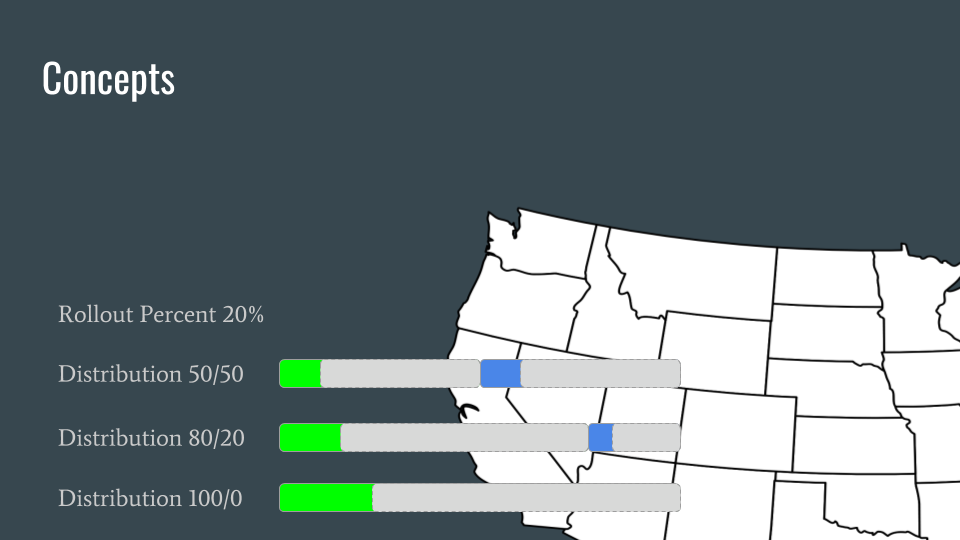
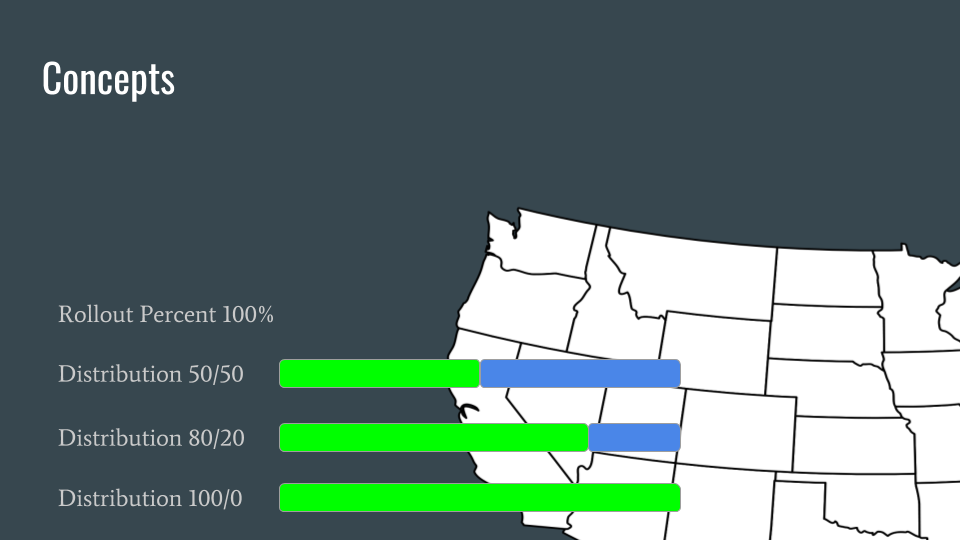
Distribution splits a matched segment across variants (50/50 control/treatment, 100/0 for a pure rollout). Rollout is the percent of the hashed sub-range that receives the chosen variant. Low rollout on a matched segment can leave variantKey empty; that is intentional holdout, not a fallthrough to later segments.
Constraint property access
Constraint Property supports dotted and bracketed paths into entityContext:
| Syntax | Resolves to |
|---|---|
state | entityContext["state"] |
user.name | entityContext["user"]["name"] |
users[0] | entityContext["users"][0] |
users[0].role | entityContext["users"][0]["role"] |
Missing keys, out-of-bounds indices, and type mismatches mean no match for that segment, not an HTTP error. Negative indices work (users[-1] is the last element).
Server-side keys such as @ts and @http_* can be merged into entityContext before constraints run when injection is enabled. See Built-in context injection.
Running example
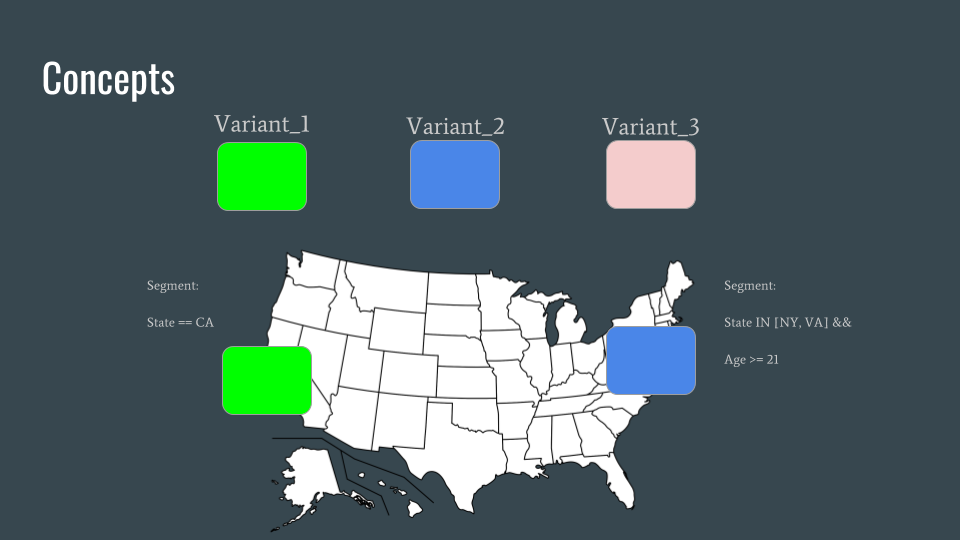
The screenshots walk one flag from a simple rollout to geo-targeted segments and a full launch. Variants define outcomes, segments define who, constraints narrow the audience, distribution picks the variant, and rollout limits how much of a matched segment actually gets one.
Setup - three button-color variants (green, blue, pink):
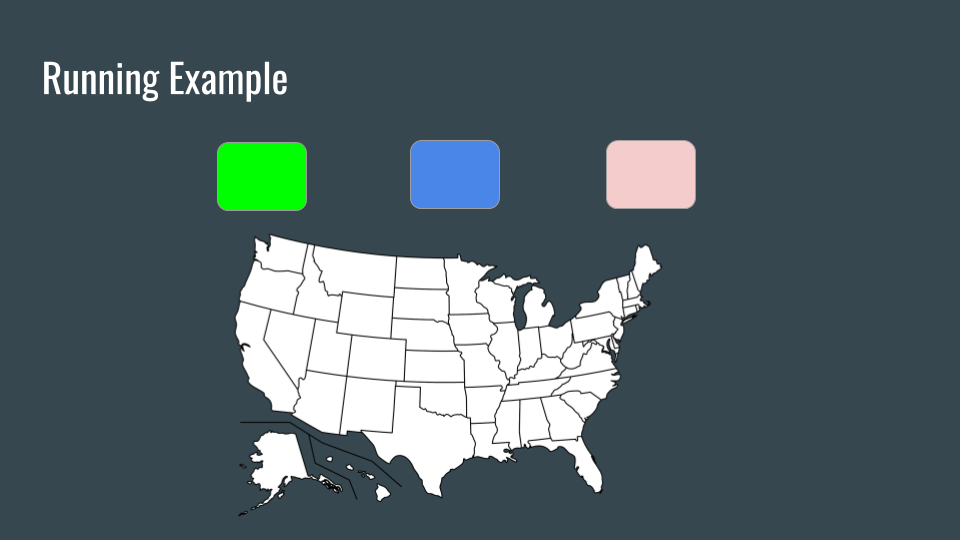
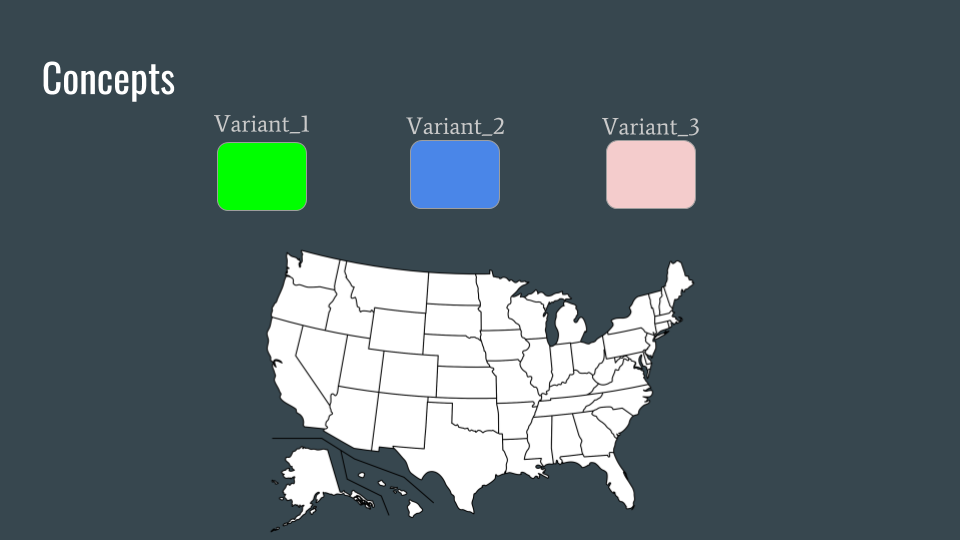
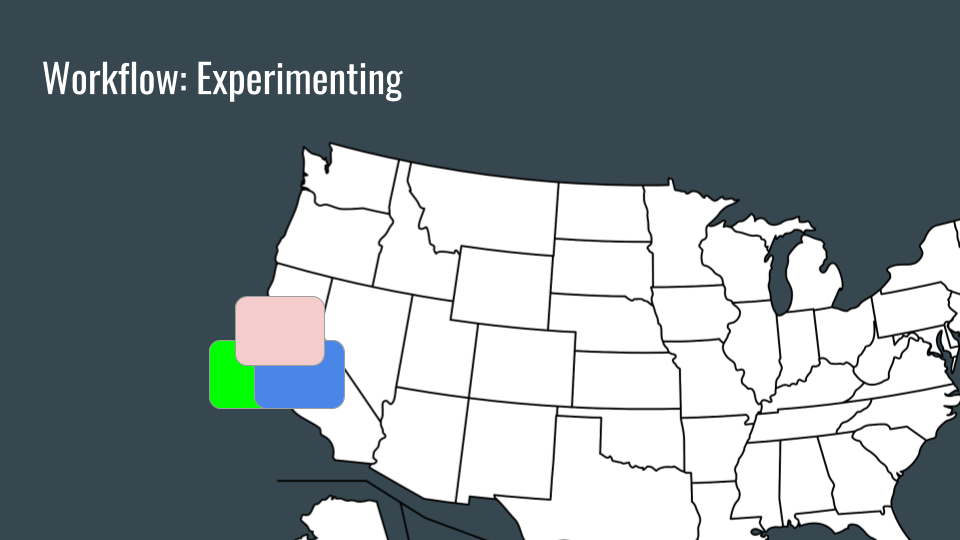
Step 1 - targeted rollout - California only (state == "CA"), partial rollout:
Step 2 - geo-specific rules - more state segments; combine constraints (state == "NY" AND age >= 21):
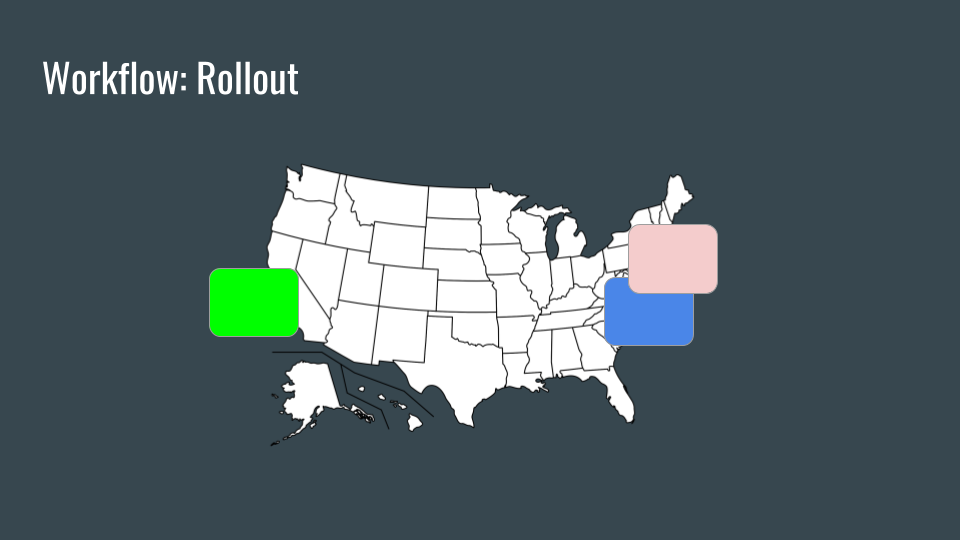
Step 3 - experiment, then launch - A/B inside a segment, then raise rollout and pin a global winner:
Rollout and deterministic bucketing
Stickiness does not require a per-user table. Flagr derives the bucket from the entity and a salt, then maps that bucket onto distribution ranges.
Source of truth: pkg/entity/distribution.go (crc32Num, TotalBucketNum = 1000). Salt is the flag's ID string (SegmentEvaluation.FlagIDStr), passed into DistributionArray.Rollout from pkg/handler/eval.go.
Given a client-stable entityID and a segment whose constraints already matched:
- Hash - IEEE CRC32 of the salt, then updated with the entity ID bytes:
crc32.ChecksumIEEE(salt)→crc32.Update(…, entityID)→sum % 1000.
That yields a bucket in[0, 999]. - Distribution - variants occupy contiguous ranges in those 1000 buckets (from each variant's percent × 10). A 50/50 split is roughly buckets
0-499vs500-999, depending on order and exact percents. - Rollout - applied inside the variant range the entity hashed into. At 100% rollout the variant always wins that range. Below 100%, some buckets in the range get no assignment. Evaluation does not continue to later segments; the request ends with an empty
variantKey.
Note: A low rollout on a matched segment can still produce an empty
variantKey. That is intentional: rollout is not "percent of users who match constraints," it is "percent of the hashed sub-range that receives the chosen variant." Segment stop rules: behavioral contracts.
Architecture
Three concerns, three latency budgets:
| Concern | Path | Consistency | Latency goal |
|---|---|---|---|
| Read (evaluation) | POST / GET /evaluation | Stale-tolerant (cache refresh) | Sub-ms hot path |
| Write (configuration) | CRUD APIs + UI | Strong (database) | Rare; off the eval path |
| Record (analytics) | AsyncRecord fan-out | Best-effort async | Must not block eval |
When a diagram and the code disagree, code wins. Shared behavioral rules: behavioral contracts.
How to read the diagram
- Clients call
POSTorGET /evaluationfor assignment, and optionallyPOST /exposuresfor impressions (Exposure logging, behavioral contracts). - Evaluator reads EvalCache only on the hot path. No per-request SQL.
- Manager owns CRUD and
flag_snapshotrows; webhooks fire after commit. - Metrics fan out async records to stream sinks or Datar. Slow sinks never block eval.
Request flows
Evaluation - POST or GET /api/v1/evaluation (GET evaluation) walks segments in rank order per segment evaluation, optionally emits AsyncRecord with recordSource: evaluation. Whether a blank result enqueues a stream row depends on the outcome: blank vs stream.
Configuration - CRUD writes the DB and a snapshot. EvalCache reloads when MAX(flag_snapshot.id) advances, or on the poll interval (FLAGR_EVALCACHE_REFRESHINTERVAL, default 3s).
Exposure - POST /api/v1/exposures validates against the cache (no constraint re-run) and records recordSource: exposure.
Eval-only - json_file / json_http drivers force eval-only mode: health, evaluation, and eval-cache export only. The UI works as a read-only browser fed by the export endpoint; writes under /api/v1/flags return 403. Details: behavioral contracts: eval-only.
Components
Evaluator - single eval, batch, tag-filtered batch; cache reload interval; snapshot max-id short-circuit in DB mode (GET /api/v1/flags/snapshots/max_id for external pollers). Code: pkg/handler/eval.go, eval_cache.go.
Manager - CRUD, POST /flags/{flagID}/duplicate, transactional mutations with snapshots. UI: Duplicate Flag, Delete Flag. Code: pkg/handler/crud.go.
Metrics - gated by recording rules. Wire format and A/B SQL: Data recorders & A/B analysis.
Related documentation
- Behavioral contracts
- Use cases - flags, experiments, dynamic config, GET eval
- Integration guide - HTTP examples
- Exposure logging and Data recorders & A/B analysis
- Datar analytics
- Environment variables - source of truth:
pkg/config/env.go